Summit of Ampersand Mountain

Summit of Ampersand Mountain
Showing posts with label General Adirondacks Information. Show all posts

Saturday, January 17, 2015

Adirondacks News #2

Here are some tidbits of Adirondacks News that I have stumbled across in the past few days...

Appellate Court Upholds Paddling Rights
from adirondackalmanack.com

Photo Credit: adirondackalmanack.com
This article in The Adirondack Almanac is interesting as it deals with a fairly tender issue in the Adirondacks: the rights of private property owners versus the right to public access. In the case in point, Adirondack Explorer editor Phil Brown canoed along a waterway which passes through private lands for an article he wrote in 2009. The owners charged him with trespass. The state appeals court confirmed a 2013 ruling which dismissed the charges against him. However, since it was a 2-3 ruling, the landowners have an automatic right to appeal their decision.

The subject touches on an aspect of the Adirondack park that I raised in my blog entry last week. As I mentioned then, just a little more than 50% of the Adirondack Park is in in private hands. Those who do own land here are subject to the most restrictive development regulations anywhere in New York State.

The subject of the article, Phil Brown, first caught my attention when I read one of his articles in a magazine at White Pine Camp titled "Osgood as it gets." It traces a canoe journey from Jones Pond (where my childhood summer camp Adirondack Swim and Trip Camp "ASTC" is located) to Osgood pond and finally up the Osgood river. Not only is "Osgood as it gets" a nice piece of writing, but it also bridges two special places to me, ASTC and White Pine Camp. I have mentioned Phil Brown (or used the map from his article) in previous blog entries, here, here and here.

(Please note: the link to the article "Osgood as it gets" can only be accessed if you create an account on Adirondack Explorer, but this can done quickly and without divulging any sensitive information.)

APA Approves Controversial Subdivision
from adirondackalmanack.com

Photo Credit: adirondackalmanack.com

Phil Brown is the author of this article instead of it's subject. You see, the Adirondacks is essentially a village.

In my most recent blog entry, I discussed about how development in the Adirondacks is regulated by the Adirondack Park Agency (APA), and there is a constant struggle between maintaining this place as a wildlife refuge and developing parts of the park for private residence, commerce or for recreation. The battle often pits economic viability against environmental conservation. I would add, this debate also pits rich people against poor people. If you look at the development plan I inserted above, it is significant to note that the subdivided parcels range in size between 3 and 145 acres - and the majority of these are on the larger end of that scale. The article mentioned that this development will generate $60,000 in new tax revenue per year. That means the largest parcel will be paying over $2400 in taxes each year. Or, to put it on another scale, the largest property is more than four times the size of White Pine Camp. By any account, the housing going in here is well out of line with the typical income of the park's year round residents. I am reminded of the era of the "great camp" where Vanderbilts, the Rockefellers, the Carnegies, et. al. staked their claim to this precious space.

Hiking Mount Jo near Lake Placid during winter’s coldest week
from ottawaroadtrips.com
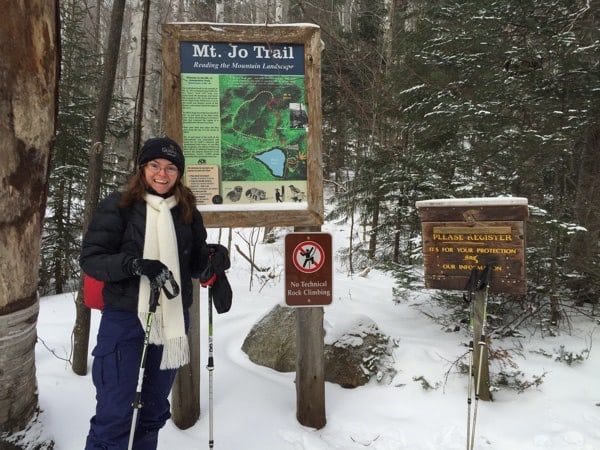
Photo Credit ottawaroadtrips.com
OK, this one is not serious reporting, nor is it an insider's perspective on the Adirondacks. But, it is a cute story about an outing in the park, and it combines two of our personal experiences with an element that we have not experienced in the Adirondacks: winter.

As I have mentioned before, Mt. Jo, was the first mountain that I climbed in the Adirondacks. On our most recent jaunt up little Mt. Jo, our journey actually continued from there to Ottawa, the starting point perspective of this article. There are two significant differences between our experience an the one mentioned in the article: we made it to the top, and we weren't subjected to -26°C temperatures. In fact, I have never experienced the park in these conditions. One aspect of the article did make me cringe though: "due to my schedule, we only had about an hour," the author writes. Accordingly, the story only takes us part way up this mini-mountain! The lakeplacid.com website describes Mt. Jo as taking two hours round trip for the experienced hiker and 2 1/4 for the "out of shape hiker." Seriously, who travels 250 km from Ottawa to write an outdoor adventure piece about the Adirondacks and doesn't allow for more than an hour on the trail?

An old favorite in winter
from adirondackexplorer.org

Photo Credit: adirondackexplorer.org
Now, here is how locals write about outings in the Adirondacks. Once again, we hear from Phil Brown. As he mentions, the fire tower still remains closed to the public. He alludes to the fact that it is slated for restoration, which I have read from other sources is scheduled to be done in the summer of 2015. I am still scouting around for more details about this restoration project. As I mentioned in a recent blog post, the trailhead to Mt. St. Regis is only a few minutes away from White Pine Camp, and it is one of the potential activities during our week there next summer.

Who Rules the World?
Podcast by Ed Kanze on mountainlake.org

Well, the connection to the Adirondacks in this podcast is perhaps tenuous, but it is from Ed Kanze, so I decided to include it here. In this podcast, Ed ponders whether girls rule the world. At the end of it, he mentions his new book "Adirondack Life and Wildlife in the Wild Wild East," which I just finished reading and warmly recommend. He also mentions a series of videos about the Adirondacks which have since been completed, you can find links to these at this previous blog entry. As Ed typically gives a weekly nature walk at White Pine Camp during the months of July and August, we look forward to meeting him then!


Sunday, January 11, 2015

Forever Wild: A Unique Park

People throughout New York State are proud of their parks in general and the Adirondack Park in particular. The fact that the Adirondacks is a state park as opposed to a national park is significant for a number of reasons, and makes this place unique among parks. However, before I get into further discussion about why I believe this is so, lets review some basic data and fun facts about the Adirondacks.

Largest Park in the Contiguous Untied States

With the exception of Wrangell - St. Elias and Gates of the Arctic national parks, both in Alaska, at 6.1 million acres, the Adirondack Park is the largest park anywhere in the United States. The seven most frequently visited National Parks in the United States (Great Smoky Mountains, Grand Canyon, Yosemite, Yellowstone, Olympic, Rocky Mountain, Zion) have a smaller combined size than the Adirondack Park. Here are a few other interesting size comparisons:
To put the size into perspective, I plotted a few German cities onto a map of the Adirondacks.

Three German cities superimposed on map to approximate similar distances
If the estimation of 10 million visitors per year is correct, then the Adirondacks has more visitors per year than any of the national parks in the United States. Interestingly however, it does not have the name recognition - at least not among Europeans - of any of the most famous National Parks, such as Yellowstone, Grand Canyon, Great Smoky Mountains, Yosemite, Death Vally and the like. Depending on your point of view, that is either a pity or a blessing, but those who don't know are missing out on the beauty and recreation that this park has to offer.

Lots to Do, lots to see

Let's get this out of the way, Mt. Marcy, the highest point in the Adirondacks at 5,343 ft (1,629 m), is not on the same league, vertically speaking, as many other famous mountain ranges, such as the Himalayas (29,029 ft), the Alps (15,780 ft) or the Rocky Mountains (14,440 ft). Regardless, unless you are singularly interested in testing your breaking point doing extreme climbing, you will find an outdoor adventure or hiking challenge in this park suitable to any skill level. Here is a brief overview of what you will find here:

Fun Facts

Wait, residents? People live in the park?

The fact that the Adirondacks is home to a significant number of private citizens brings me back to my point about why the Adirondacks are unique and the fact that it is a state park plays a defining role in this. Together with the Catskill Forrest Preserve, also in New York, the Adirondacks are the only constitutionally protected forest lands in the United States. This is also part of the mythology of the Adirondacks, making it a special place for visitors and residents alike.
The lands of the state, now owned or hereafter acquired, constituting the forest preserve as now fixed by law, shall be forever kept as wild forest lands. They shall not be leased, sold or exchanged, or be taken by any corporation, public or private, nor shall the timber thereon be sold, removed or destroyed. (Article 14 of the NY State Constitution) 
Source: Wikipedia
However, the fact that the Adirondack Forest Preserve exists and is protected by the New York State Constitution does not in and of itself explain how it is that people can live here. The Adirondack Park is an area delineated by an outer boarder called the "blue line" which is made up of areas with different classifications, and slightly more than half of the 6.1 million acres is actually private land. The entire park is divided up like this:
Source: Adirondack Park Agency
Represented on a map, the utilization of the park looks like this:
Source: Adirondack Council
The Adirondack Park is thus a patchwork quilt of private and public land. While it is true that the Adirondacks and the Catskills enjoy the highest degree of protection of wild lands in any state, the cause is not as singularly noble as it may sound. The origin of this protection was in fact very pragmatic and served to protect commercial interests. The forests in the park were heavily logged during the time after the Civil War, and the state's business community began to fear that this could cause erosion and make the Erie Canal unnavigable through silting. In retrospect and particularly considering the United States, nowadays it is a very quaint idea to think that such a monumental act of environmental protection came about as the result of a political initiative serving to protect business interests.

Also, the protection of the park is the subject of much controversy. On the one hand, it is probably safe to say that the private lands in the Adirondacks and the Catskills are subject to the most stringent development restrictions anywhere in New York State, further challenging prosperity in an area prone to economic depression even without such restrictions. On the other hand, the Department of Environmental Conservation which manages both the Adirondacks and the Catskills, as well as the Adirondack Park Agency, charged with performing long range planning for the future of the Adirondack Park, have both fulfilled their functions - how shall I say - inconsistently over the years. As with any public service agency, operations are very much dependent on the funding and staffing they receive, and both of these variables have been manipulated to varying effects in relation to the political persuasion of the state's government over time. For an in-depth discussion of this issue, I recommend Paul Schneider's book "The Adirondacks: a history of America's first wilderness" Also, anyone interested in learning more about life in the Adirondack Park, including how this legal framework has an impact both on humans and nature, should definitely visit the Adirondack Museum.

In his book "Adirondack Life and Wildlife in the Wild, Wild East," Ed Kanze also discusses the uniqueness of the Adirondacks and puts it into the context of the competing philosophies of the naturalists John Muir and John Burroughs. Kanze explains that Muir believes nature is best protected when humans are kept away, but himself feels aligned with Burroughs' hypothesis. Burroughs argues that humans are of nature as opposed to being apart from it. Accordingly, the ideal state would be to live in harmony with nature as opposed to separate from it.

Kanze continues, explaining that Muir's thinking is what gives rise to the cathedral like setting which can be found in any of the national parks in the United States. These are places where entry is regulated - usually with an admission fee and often limited in numbers - activity is limited and supervised by the priests, ...err... that is rangers, of the parks. The Adirondacks, on the other hand, is very much of the Burroughs school. It is a place where people live and earn their livelihoods. The "blue line," which delineates the park's outer perimeter, is entirely permeable. You can cross it at cruising speed on the road, casually noting a signpost. Or, if you enter by ferry over lake Champlain, you have already entered the park prior to the boat docking on the New York side. The theme of living as part of nature is returned to several times in Kanze's book. Indeed it is the very foundation of many of the premisses in it and also of his own livelihood in the Adirondacks as well as that of his family.

Source: panoramio.com


Thursday, January 1, 2015

Moose in the Adirondacks

The Moose, alces alces, is the largest member of the deer family and has an estimated population in NY State of 500 to 800 as of 2010. We have yet to encounter a moose in the Adirondacks, but there have been sightings on Osgood River, near to White Pine Camp in 2014.
MOOSE confirmed at WPC! First time guest Bob Allbery and wife from Ohio paddled the Osgood River and saw 3 moose: a cow and large calf about 2+ miles down and then another cow about a mile from the mouth of the river! There was a report by another guest of one standing near the shore in view of WPC a month ago. (posted to White Pine Camp Facebook Page, September 18, 2014)
Moose sighting on Osgood River, Photo Credit: Bob Allbery
source: White Pine Camp Facebook page
We have had very close-up sightings of deer, once seeing two generations together immediately outside our cabin at Adirondack Swim and Trip Camp. Apparently, deer and moose rarely cohabitate because deer carry a parasite which is deadly to moose.

While sightings are rare and celebrated these days, moose were commonplace in the 1800s, the age of the Adirondack guides. Guide Alvah Dunning was credited with killing the last moose in the region sometime in the 1860s (accounts vary as to the exact year).

Hamilton County sighting, Photo by Gary and Karen Lee, source DEC Website

Here is a video showing giving us a peak at this fascinating creature and some interesting information. (Unfortunately, the creator disabled the youtube imbed function.)

I think in the simplest possible terms, the moose is a symbol of both the richness and the history of the Adirondacks: it has a rare and unique beauty, it flourished in the wild until being brought onto the verge of demise through human interaction, and it is making a tentative and uncertain comeback. On second thought, that characterization is much too dramatic for the Adirondacks writ large. I believe that the current state of the Adirondack park is much more robust than that of her inhabitant the moose.

Dear moose, we hope to catch a glimpse of you on our next visit to White Pine Camp.

Saturday, December 13, 2014

Adirondack Mountain Club Blog

By now, anyone who has been following my blog knows that I enjoy writing about how much I love the Adirondacks. I am quite happy if I have been able to communicate that love to you and entertain you with sometimes quirky stories about Adirondack Swim and Trip Camp, fun things to do, mountains to climb or just hanging around White Pine Camp.

Every once in a while, I am reminded that there are others who are more eloquent at sharing their love for the Adirondacks than I. The youtube video series by Ed Kanze and his most recent book are cases in point. Neil Peart also writes with an eloquence that I can only dream of approaching, but he writes about the Laurentians (among many other things), so we will just consider him out of competition when it comes to the Adirondacks. As I mentioned in a previous post, the Laurentians have a very strong geological relationship to the Adirondacks and are located just north of the border in Canada. Recently, another writer has come to my attention who does a great job of sharing the essence of the Adirondacks in prose.

Jacqueline Keating, Photo credit adkmtnclub.blogspot
Jacqueline Keating's post on the Adirondack Mountain Club blog struck a chord with me for a number of reasons. First of all, she is too far away to just hop over for a weekend getaway. Thusly, her post is entitled "Love from a Distance." For me, it has many elements of a great post about the Adirondacks...

…a dramatic opening with a self-effacing sense of humor:
It was love at first sight. When it happened, I was too young to have ever had been in a serious relationship before, but I knew it was the real thing. When we were apart, I thought about nothing else. When we were together, there was nowhere else I wanted to be. I would anxiously count down the days until our next reunion, my heart rate accelerated and my eyes filled will (sic) happy tears whenever I caught that first glimpse after time spent apart.
…she reminds us that the Adirondack Mountains are much smaller than many others on this planet, but still they transfix us:
When I returned to work my second season with ADK, the High Peaks that were a mere third of the size of the mountains I had spent the previous months on were more spectacular than ever.
…and, she conjures up images of places that I have a very personal connection with:
My second-to-last day on the east coast before moving to Kodiak, Alaska, in the fall of 2013, I climbed Mt. Jo for my last look at Heart Lake to reflect on all the places that landscape has inspired me to explore.
Heart Lake viewed from the summit of Mt. Jo

She also mentions "a framed personal photo of Marcy Dam two weeks after Hurricane Irene," which is (hmm, was?) a dramatic gateway to the most popular destinations in the Adirondacks, including the crowned jewel, Mt. Marcy.

Here are our pictures from the site of Marcy Dam, before and after Hurricane Irene.
Marcy Dam, June 2011

Marcy Dam, June 2011

Post Hurricane Irene, August 2013
So, thanks goes out to Jacqueline Keating out there in cyberspace, for conjuring up memories about and emotions for our beloved Adirondacks in your lovely blog post!

Jacqueline has worked for the Adirondack Mountain Club, also known simply as "ADK." When we go hiking in the Adirondacks, ADK is a constant companion in ways which are visible and some which are not. They have interpreters that spend time at many popular locations in the park, including on the summit of Mt. Jo, to educate people about the wilderness and provide help when needed. They have a very strong mission to educate about conservation and safety. They perform trail maintenance, including the erection of a replacement bridge after Marcy Dam was destroyed, and they help mitigate the human impact on the park. Last but not least, they provide a wide range of services for hikers and campers, including maintaining the parking lot adjacent to Adirondack Loj, and they offer information about trail conditions, lodging, supplies and nourishment at their facilities. The five focus areas of ADK are:


Bridge constructed by ADK after the Marcy Dam Bridge was destroyed

Friday, December 5, 2014

Curiously Adirondack - Catch Our Drift: Why Adirondackers Love Winter, Sort Of

Here is the final new addition to the "Curiously Adirondack" youtube video series by Ed Kanze and Josh Clement.

In this episode, local residents hunker down for a snowy winter.

The entire series consists of eight episodes, which can be found online:

Catch Our Drift: Why Adirondackers Love Winter, Sort Of
Fifty Beds, Two Lakes, And An Otter: Bartlett's Hotel In Its Heyday, 1854-1884
Intervale Lowlands: Biologist Larry Master Re-Wilds 135 Acres Near Lake Placid
What Does The Moose Say?
Adirondack Exercise Club
Dirt, Food, and Friends: Fledging Crow Farm Celebrates The Harvest
Asleep Beneath The Sod: Saranac Lake's Historic Pine Ridge Cemetery
Slimed! Adirondack Kids Love Amphibians!

Ed Kanze, photo credit http://www.edwardkanze.com


You can also find a link to a longer interview of Ed Kanze in my previous blog post here.

And, one of Ed Kanze's books is among my recommended books about the Adirondacks, which I list in this blog post.

Those joining us at White Pine Camp will have the opportunity to go on a nature walk with Ed.

Saturday, November 29, 2014

Adirondacks Reading List

There are lots of great books about the Adirondacks. The ones I have singled out here are those I think will me most interesting and useful in connection with our get together at White Pine Camp.


The Adirondacks: A History of America's First Wilderness

This book is the most comprehensive history of the park that I have read, going back to early colonial times. This book is has been a great resource for me, and I have drawn from it a number of times in various blog entries. It is also a great read.

available

___________________________

Adirondack Life and Wildlife in the Wild Wild East
by Edward Kanze

This book is on my current reading list, and I can't wait to get a copy!

It is a very personal account by Ed Kanze about establishing his homestead in the park, where his ancestors settled generations ago. As a lifelong naturalist, he weaves his own personal family story with that of the history of the area and also has lots of keen obesrvations about the wildlife in the park. In my recent blog entry, I have more information about Ed Kanze, including a video of Ed discussing this book, among other things.

I very much look forward to meeting Ed next summer while at White Pine Camp. We will do our best to make sure that a nature walk is coordinated with our time in camp.

Other books written by Ed Kanze are described on his website. It is also possible to order books, also autographed copies, directly from the Author by filling in your information and the name of the book you want here. (Those joining us at White Pine Camp can save shipping by asking him to bring a copy with him when he gives his Tuesday nature walk at camp.)

available
- at amazon.com
- at amazon.de
- at The Bookstore Plus (East Main St. in Lake Placid, NY)

___________________________

 
Adirondack Trails High Peaks Region (Forest Preserve, Vol. 1)
by Tony Goodwin

This is the quintessential guide to have with you on the trail in the Adirondack High Peaks. It is part of a series with eight seven volumes, the others being Northern, Central, Northville-Placid Trail, West-Central, Eastern, Southern, Catskills. With the exception of the volume on the Catskills, all of the remaining volumes are for other geographical areas in the Adirondacks. The book also includes a topographic map of the hiking trails covered in the book. The series is published by ADK, the Adirondack Mountain Club, which is dedicated to protecting the New York State forest preserve and promoting its responsible use. We have wanted to get a copy of the Northern Region guide as well, since this one covers the Paul Smiths area - but it appears to be out of print. Checking amazon.com, which is currently offering a new copy of the book for $106 and a used copy for $25, seems to confirm that suspicion. Luckily, the guide to the High Peaks region is a classic that will likely be available forever.

One critique that I have read about the 13th and 14th editions is that they are not as "trail friendly" as previous editions. The older guides had a quality stitched binding, a water resistant semi-stiff cover, rounded corners and a size that fits in a hiker's pocket. Starting with the 13th edition, which we also have, they have changed over to a basic glued binding, flimsy laminated cover, square corners and larger format which you can no longer conveniently stuff into your back pocket.

available
- at amazon.com (Caution: appears to be a marketplace offer for the previous edition only!)
- at amazon.de (I won't include the link because the price listed is prohibitive!)
at adk.org

Note: Amazon.com only appears to be showing the 13th Edition, which is no longer in print. I still included the link to the amazon.com site as it has the handy "Look Inside" feature, giving you a good impression about what to expect from this book. I was only able to find the 14th edition directly at the Adirondack Mountain Club (ADK) website. ADK is also the publisher of the book.

___________________________

Discover the Northern Adirondacks: Four-Season Excursions from Lake Placid, Saranac Lake, and Points North
by Barbara McMartin & Bill Ingersoll

This book is complimentary to the High Peaks guide mentioned above, but centered around the White Pine Camp area. This one fills the void left by the ADK series mentioned above. It also gives interesting historical information and a reproduction of a topographical map in black and white, in a 15 page section of the book. It is a particularly good resource if you are considering the camping option I mentioned in my recent blog entry.

available
- at amazon.com
- at amazon.de (I won't include the link because it only references an old 1988 edition, which is currently not available)

___________________________

Kids on the Trail: Hiking With Children in the Adirondacks
by Rose Rivezzi and David Trithart

Great book to find hiking trails in the Adirondacks that are fun for kids and as well as parents and other adults joining them. The book also has ideas to help children learn to love hiking and get the most out of the experience, with special considerations for infants and toddlers (0-2), young children (2-5) and older children (6-12).

I first discovered this book as reference guide on hand at Adirondack Swim and Trip Camp (ASTC). I mention this in particular because the folks at ASTC really know the high peaks region, and took me into the high peaks on overnight hiking trips many times. I discuss my experience with ASTC in detail here, have listed the trails I have climbed with ASTC (and since) here, and discuss my first ASTC climb here.

This book is also published by the Adirondack Mountain Club.

available
- at amazon.com
- at.amazon.de

___________________________

Essex On Lake Champlain, NY
by David C. Hislop Jr.

Of particular interest for anyone approaching from the east, perhaps crossing Lake Champlain on the ferry. Read my blog entry about Essex on Lake Champlain for more information and links to additional resources.

available
- at amazon.com
- at amazon.de

Other Adirondacks Reading Suggestions

Also, check out the fall reading list listed on adirondack.net for more great book suggestions.

Saturday, November 15, 2014

A Short History of Paul Smiths

As I have mentioned before, the Adirondack Park is a place of beauty with unique dimensions. Including some 6.1 million acres, it is the largest park in the contiguous United States, and it is a matter of pride among New Yorkers that it is a state park, with a forrest preserve protected as "Forever Wild" by the NY State constitution, "and thus enjoys the highest degree of protection of wild lands in any state." The park easily merits a visit on the virtue of its sheer physical dimensions and beauty alone, to experience the mountains, lakes and streams, as well as the wildlife and vegetation. However, it would be a glaring omission to overlook the human history of the Adirondack Park.

The Adirondacks are a microcosm of the history of the United States. The park bears witness to so many elements of the American journey, from trading animal skins with native peoples, to the preindustrial activities such as logging and mining, to the rise of the "robber barons" in the industrial age, the scars left by the resulting pollution including notably acid rain, to the developing awareness of the need for conservation and protection of the wilderness. If you know where to look, it is easy to explore a cross section of these historical developments while visiting the Adirondacks, the hamlet of Paul Smiths and even White Pine Camp itself.

To properly explore the human history of the park, you would need to go back long before the time of the British Colonies here and learn about the Haudenosaunee, more commonly known as the Iroquois Confederacy, consisting of the Seneca, Cayuga, Onondaga, Oneida and Mohawk peoples. Early settlers came to trade furs with them, some with the intention to convert them to Christianity.

The European settlers were active in trapping, hunting and fishing in the Park. As the United States came into existence and its economy grew, the natural resources of the park were exploited, including logging for building timber and paper pulp. Mining also played a significant role in the park's history.
Miners in Joker Mine, Photo Credit: Adirondack Museum
These endeavors were intertwined with the rise of the industrial age and the "robber barons" who majestically capitalized on them. The Rockefellers, Vanderbuilts and J.P. Morgan are notable among many of the rich and powerful who staked a claim in the Adirondacks, commissioning the construction of great camps.

Much in the sense that the Adirondacks is a microcosm of American history, the hamlet of Paul Smiths is a microcosm of Adirondack history, and by extension, White Pine Camp is a microcosm of the history of Paul Smiths, named after Apollos (Paul) Smith, the decisive personality who shaped this area, its economy and the utilization of the park.

Map of Paul Smiths plus Osgood Pond and Jones Pond, from google maps
Smith, born August 20, 1825 in Milton VT and died December 15, 1912 in Montreal, Canada, was an inkeeper, a lumber baron, land developer, shrewd businessman and avid outdoorsman. At the age of 16, he left home to work on a canal boat on Lake Champlain and went hunting and fishing in the Adirondacks in his spare time. He gained a reputation as a hunting and fishing guide in the Loon Lake region.
Photo Credit: Wikipedia 
From his earnings, in 1848 he rented a house on Loon Lake which he ran as a small hotel that was frequented by doctors and lawyers and other wealthy guests. In 1852, he bought 200 acres near Loon Lake for $300 and opened "Hunter's Home," a fairly primitive operation. The ground floor consisted of a large living room, kitchen and a barrel of whiskey with a dipper. Drinks were self-service at four cents each, on the honor system. The upper floor consisted of ten small, simple sleeping quarters. The endeavor was hugely successful, and Smith's clientele, with whom he had developed relationships over the years, suggested that he build a more substantial hotel. Thus was born the Saint Regis House, known better as Paul Smith's Hotel, probably the most famous Adirondack hotel of all time. I highly recommend taking a look at the article on localwiki about the hotel, it includes numerous fascinating pictures.

Paul Smith's Hotel, circa 1892, Photo Credit: Wikipedia
Paul Smith's Hotel was opened in 1858 with seventeen rooms. Over the next three decades, it grew to five hundred rooms along the shoreline of Lower Saint Regis Lake. His clients were among the wealthy elite of the day who in turn wanted to build their own private Adirondack Camps, which furthered Smith's business endeavors even more.

Smith was a real estate developer on a huge scale. He purchased as much land as possible around his hotel, at one point owning up to 40,000 acres. He also knew the art of the deal, selling four acres (some accounts say five acres) in 1896 for $20,000, exactly the same amount he paid for 13,000 acres just a few years earlier. That's about $570,000 in 2014, adjusted for inflation.

Fun fact: how big is 40,000 acres anyway?

To put it into the context of the Adirondack park, Smith's holdings amounted to roughly 0,66% of the total area of the 6,100,000 acre park. By the way, there are 99 countries and dependencies in the world (out of 249 in total) that have a total area smaller than that of the Adirondack Park, including Belize, Slovenia and Israel. Bosnia and Herzegovina is slightly more than twice the size of the Adirondack Park.

Many of the most famous Great Camps of the Adirondacks were built on land purchased from Smith and constructed with wood from his mills.

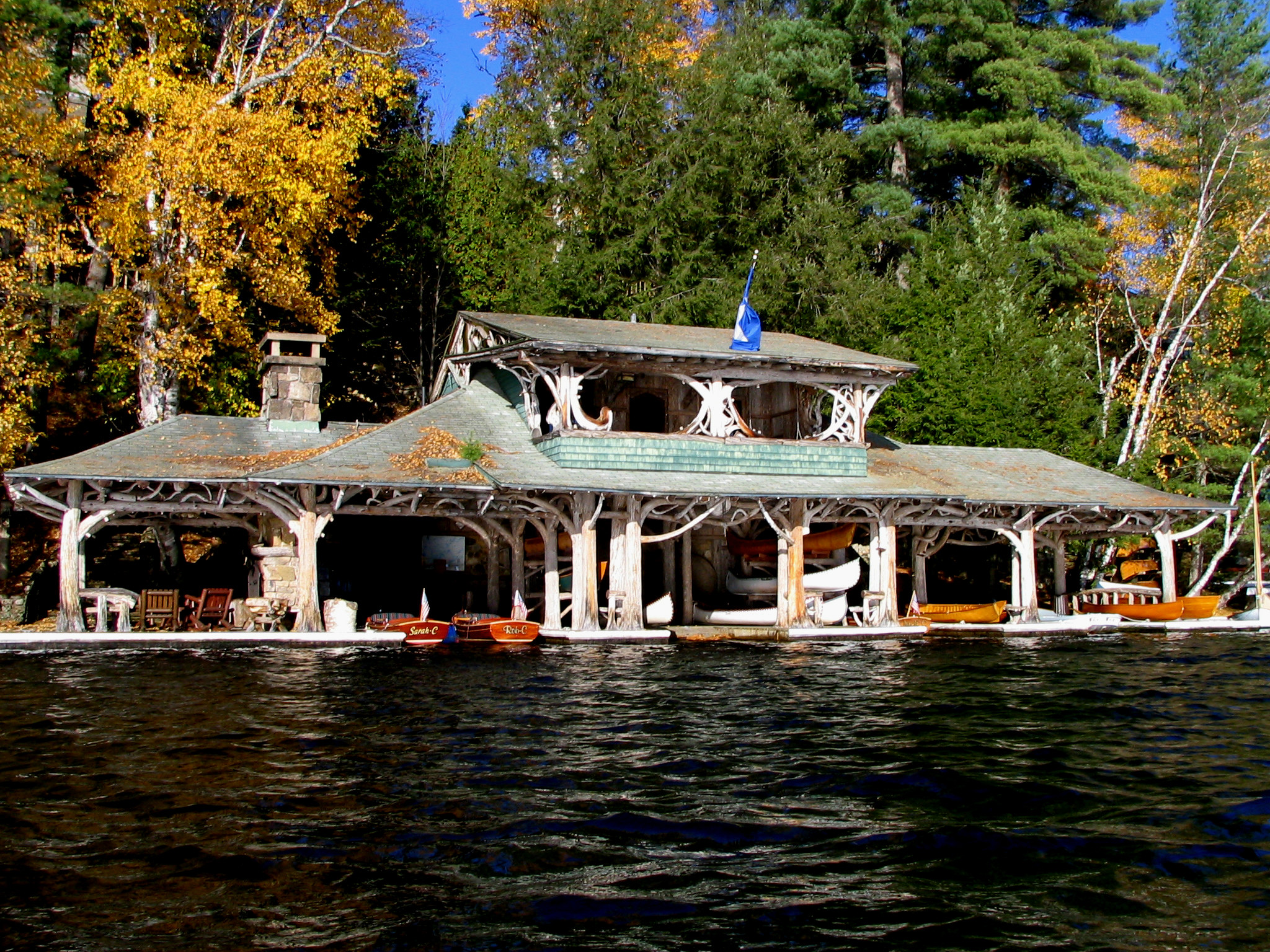
One of the Boathouses of Camp Topridge, on Upper St. Regis Lake, Photo Credit: Wikipedia
One of Smith's many clients was Archibald S. White, a prominent New York banker, and his wife Olive. The Whites purchased 35 acres on what is now known as Osgood Pond, and in 1908, the construction of White Pine Camp began, joining the ranks of the Adirondack Great Camps.

The Old Boathouse at White Pine Camp
Smith's business ventures were highly diversified. Some of his operations were typical of what one would expect in the Adirondacks: logging, developing and operating a saw mill, stores and shops. However, his operations were much more wide ranging. He also built an electric railroad to make the seven mile connection to the Mohawk and Malone Railway. Another technological development was the creation of the area's first electric company, with several hydroelectric plants. He also built roads, developed electric boats, installed telegraph lines and a stock ticker which was wired directly to the New York Stock Exchange. Later, he even set up a telephone system. Some of the activities of Apollos (Paul) Smith may remind those of us working at a particular "electrification company" here in Germany of another historical inventor and industrialist who lived during the same era.

Paul Smith's Electric Light and Power and Railroad Company
building in Saranac Lake, which now serves as the village offices
Photo Credit: localwiki
After Smith's death in 1912, his son Phelps Smith continued to operate the hotel until it burned down in 1930. When his son died, the funds in his will were provided to start Paul Smith's College, which offers degrees which are steeped in the tradition of what Apollos (Paul) Smith developed during his lifetime:


The history of White Pine Camp, is intertwined both in Smith's personal history and his legacy. In 1948, then owners Edith Stern & Adele Levy, daughters of Sears-Roebuck's Julius Rosenwald, donated the camp to Paul Smith's College. It was during this time, 1948 - 1983, that the camp fell into a state of disrepair through heavy use and years of abandonment from 1976 to 1983.

In 1983, Warren Stephen purchased the property and was able to stabilize some of the buildings. Ten years later, Howard Kirschenbaum purchased the camp and did extensive work to restore and overhaul it. Since 1997, White Pine Camp is operated as a LLC, with nearly 40 owners, many of whom take very much a hands-on approach to preserving and developing their camp. Reborn as a place of natural beauty as well as historic and architectural significance, the camp is strongly committed to being a place of living history. More details about the history of White Pine Camp can be found on their website.

Portions of the above sections were paraphrased from the localwiki article about Apollos (Paul) Smith, the description of White Pine Camp's history on the White Pine Camp website, and the book The Adirondacks, A History of America's First Wilderness, 1997, by Paul Schneider (available at amazon. com and amazon.de).

How to Experience Adirondack history and the legacy of
Apollos (Paul) Smith during your next trip to the Adirondacks

Friday, October 31, 2014

Life In the Adirondacks: Ed Kanze extended Interview / New Episode of "Curiously Adirondack"

We have seen naturalist Ed Kanze wandering around White Pine Camp, but we haven't participated in one of his nature walks, yet. We plan to do that next time!

Here is an extended interview of Ed Kanze on Mountain Lake PBS (Website / Youtube Channel)


Ed Kanze's book mentioned in the interview, "Adirondack Life and Wildlife in the Wild Wild East" is available 

Other books written by Ed Kanze are described on his website. It is also possible to order books, also autographed copies, directly from the Author by filling in your information and the name of the book you want here. (Those joining us at White Pine Camp can save shipping by asking him to bring a copy with him when he gives his Tuesday nature walk at camp.)


Last but not least, the most recent episode of "Curiously Adirondack" is online now, called:

Intervale Lowlands: Biologist Larry Master Re-Wilds 135 Acres Near Lake Placid
Here is the video of this episode:


Here is the playlist of the entire series "Curiously Adirondack," starting with the most recent episode (currently the same as the above).

Saturday, October 25, 2014

Loons, Lakes and Erratics in the Laurentians

This week's post is the nexus of two of my loves but is only indirectly related to either of them. One of these is the Adirondacks and the other is Rush.

North of Quebec City you will find the Laurentian Mountains, which share types of rocks and geologic history with the Adirondacks. The Adirondacks are often mistakenly associated with the Appalachian Mountains as they appear to form the central northern continuation of these. But geologically speaking, the Adirondacks are actually the southernmost extension of the Laurentians. Both share a history that goes back anywhere between 500 million and a billion years.

Google Maps Screenshot of the Laurentians
I just found a really good blog post about the geologic makeup of the Adirondacks at "Written In Stone … Seen through my lens." There you can find a much more detailed and scientific examination of the region's geology. I "borrowed" the next image from that blog. In it you will see the green highlighted area which encompasses both the Adirondacks and the Laurentians.

Image from written in stone seen through my lens

My attention was drawn to the Laurentians this past week by Neil Peart, the lyricist and drummer of my longstanding favorite band Rush, thus my second indirect reference. Peart has maintained a vacation home in the Laurentians for many years and wrote about it in his most recent blog entry, titled "Science Island." Before I even got into the text of his story, I was immediately struck by the pictures he posted which for me have a lot of connective tissue with the Adirondacks. A typical characteristic for me is this juxtaposition of trees and rocks. Getting into his story, I sense this vibe of rejuvenation, recreation and harmony with nature which also mentally places me in a familiar scene in the Adirondacks.

I think that Peart is much more eloquent in describing "his" Laurentians than I am at describing "my" Adirondacks, so I would like to share two excerpts from his post that could have been just as fittingly written in and about the Adirondacks, even describing the sights and sounds on Osgood Pond, home to White Pine Camp.

Google Maps Screenshot of Osgood Pond

Two things in particular that Peart mentions are "erratics," and loons. Here are excerpts from his blog about each.

About the "erratic block:"
Near the wooded, boulder-studded shores of those four islands, a few tiny islets of rock stand above the water here and there. One of them has a steep cliff into deep water that was always fun for a gang of us to jump off of. Twenty-four years ago just one solitary fir tree grew on its crown, so it became known as l’Île de Noël. (Christmas tree, see.) One neighboring couple told me that in the early years, before there were many houses, an unnamed couple once made the beast with two backs there. So they called it l’Île d’Amour. A large granite stone, an “erratic block” (meaning dropped by a retreating glacier), on top of it suggested the shape of an eagle’s head to this bird-brain, so our family called it Eagle Rock. With a young boy’s natural reductiveness, Brutus’s son Sam called it Rock-on-Top-of-Rock.

Eagle Rock, photo from neilpeart.net
 About the beloved loons:
One of the oft-celebrated delights of northern lakes is the calls of loons. In our area, each lake has a resident pair that returns year after year. Their vocal tremolos are familiar in movie and TV soundtracks, and even in pop music. (…) Their various songs are eerie, unearthly, and endlessly haunting, especially on moonlit nights, when they can fish and move around the lake, calling to each other. Olivia and I had been seeing “our” pair of loons often, with their new baby chick. That is always an exciting event on the lake, because loon nests often fail due to a rising or falling waterline, or predators. 
Most birds have hollow bones, but those of loons, one of the most ancient of species, are solid and heavy. That weight is helpful for diving deep in search of fishy food, but not for getting airborne—loons require a long laborious taxi across the water. Their feet are far back on their bodies, likewise good for swimming underwater (they also use their wings), but they cannot walk. The nest has to be right at the water’s edge, where they can push themselves onto it. If the water falls, they won’t be able to get to the nest; if it rises, the eggs float away.
"Riding Loonie-Back", photo from neilpeart.net
Peart's discussion about loons and geology goes into further detail and is a great read, I highly recommend his entire blog post.

He also discusses different forms of recreation at his vacation spot, including rowing - another excellent outdoor activity which can be enjoyed at White Pine Camp.

"The Professor" himself (Neil Peart), photo from neilpeart.net
I don't want to get too off topic, but there are a few details you should know to make some sense of some of the references in Peart's blog post. Peart tragically lost his first daughter, Selena, in a car crash. Then his wife became ill and died of cancer. The band of course was on indefinite hiatus after these twin tragedies. Peart has since remarried, has returned to these same woods and shares them with his wife, Carrie and their daughter Olivia. These details are loosely referenced in his blog post.

As is characteristic of his vacation posts, he does not focus much on the "Guys at Work," but the topic does come up as he visits Le Studio, the now defunct recording studio where Rush recorded several of their albums, including their biggest selling album "Moving Pictures" (1981).

I leave you with a song, "Between the Sun and Moon," with Lyrics written by Peart. I am sure that his retreat in the Laurentians inspired this song.  A few more points of significance: the video below was taken from the band's first concert after returning from their hiatus, in Hartford Connecticut on June 28, 2002. The song itself however was written before Peart lost is first wife and daughter. The concert was held one day after the passing of The Who's bassist John Entwistle. The performance of the song is the the first time they ever played it live and is dedicated to him.

Between The Sun and Moon (1993)

There is a lake between sun and moon
Not too many know about
In the silence between whisper and shout
The space between wonder and doubt

This is a fine place
Shining face to face
Those bonfire lights in the mirror of sky
The space between wonder and why

Ahh, yes to yes to ahh, ahh to yes
Why the sun?
Why the sun?

There is a fine line between love and illusion
A fine place to penetrate
The gap between actor and act
The lens between wishes and fact

This is a fine place
To hesitate
Those bonfire lights in the lake of sky
The time between wonder and why

Ahh, yes to yes to ahh, ahh to yes
Why the sun?
Why the sun?

Some need to pray to the sun at high noon
Need to howl at the midwinter moon
Reborn and baptized in a moment of grace
We just need a break
From the headlong race

This is a fine place
Shining face to face
Those bonfire lights in the mirrored sky
The space between wonder and why

Ahh, yes to yes to ahh, ahh to yes
Why the sun?
Why the sun?

White Pine Camp on Google Maps


View White Pine Camp in a larger map