Summit of Ampersand Mountain

Summit of Ampersand Mountain

Saturday, November 22, 2014

Other Accommodations

Before I began writing this blog, there was this idea about inviting our friends and family to join us for a week at White Pine Camp to celebrate our cumulative 90th birthday. The bit about the birthday was admittedly a bit contrived, but our focus has always been on sharing one of our favorite places, the Adirondacks, with some of the people closest to us. So, we have been talking about this idea for three years now, and the most important details of the trip have since been settled: we have a confirmed group of people joining us, and we have reservations at White Pine Camp.

The logistics of the idea were daunting from the start. Our friends and family are spread out over several countries on two continents, some are teachers and some have children in school. We decided to choose a week that created the least number of conflicts with family and work schedules, but this meant that we are in the middle of the peak season. Many expressed interest, but a significant number weren't able to make a firm commitment in time for us to secure a place for them at White Pine Camp. We currently have three cabins reserved, all spaces are allocated, and White Pine Camp is otherwise fully booked for the week of our stay. For those still interested in joining us, there are still several alternatives.

There are three basic ways that you can be near to White Pine Camp while we are there: Camping, staying in an RV Camper, or finding other lodging accommodations in a rental cabin, nearby camp, B&B, inn, motel or hotel. We will be happy to help you sort out the details with regard to any of these options if you would like to join us. What follows is a general guide to each alternative.

Camping

Those in Germany and many other places in Europe typically aren't familiar with primitive camping which is common in the Adirondacks and other wild places in the United States. For them, "camping" is pitching a tent or staying in a camper on an organized campground that has a certain level of infrastructure, often including central sanitary facilities and even a kiosk/snack bar with things to eat and drink. The one European exception that comes to my mind is in Sweden, where there are broad rights to pitch a tent just about anywhere in the wilderness, including in many cases, on private property. With the exception of pitching a tent on private property, the idea of camping in the Adirondacks has a lot in common with the Swedish idea.

You are pretty much good to go, as long as you are familiar with the camping regulations of the New York State Department of Environmental Conservation (summarized in brief by the Adirondack Mountain Club, with more information about protecting your food from bears here).

If you are interested in planning a camping trip to coordinate with our get-together, then proximity to White Pine Camp is key.  As you can see in the map below, there are lots of nearby options. White Pine Camp is at the end of White Pine Road, so you will be closest to us if you can find a campsite on Osgood Pond. And if you have or rent a canoe, you can paddle over to visit us.

Excerpt from Adirondack Paddler's Map For Canoe & Kayak Travel
Published by Paddlesports Press
Tent or Lean-to?

The most common way to do primitive camping is pitching a tent in the wilderness. It will also give you the most flexibility of options to coordinate with our trip. In the Adirondacks, there is an alternative way to get shelter: a lean-to. Pictured below, a lean-to is a three sided structure with a solid roof above your head. In the event of rain, there is a better chance of staying dry in a lean-to than in a tent (with water seeping up from below), but the tent will give you more protection from mosquitos and the myriad flying insects that you will encounter while staying in the Adirondacks. Either way, bug spray should be in your list of things to bring. Other benefits of lean-tos are that they have a certain amount of infrastructure, including a fire pit, and they are often scenically located overlooking a nearby river or pond, as is the case on and near Osgood Pond. The biggest drawback to the lean-to is, for the most part, they are strictly first come, first served. Since these are public property, many smaller groups will share "their" lean-to with you, but you may or may not be comfortable doing that.

Around Osgood pond, looking at the map above, you will see that there are about four lean-tos, indicated by the red symbol with a structure on it that looks like half a house. If you are pitching a tent, there are "primitive campsites" indicated with a red "+"on the map. These are essentially small clearings, each with a fire pit. Sometimes there is a privy near to an established campsite or lean-to, but not always. The primitive campsite at the north corner of Osgood pond is easiest to reach via canoe. On the other hand, the campsite along Jones Pond Road on the far right of the map section above is very easy to get to, with drive-in access. That one is occupied relatively often, and not the quietest place to camp because of the proximity to the road.

Classic Adirondack lean-to, photo from White Pine Camp Facebook page
Regardless of lean-to or tent, you will want to get an early start when looking for a campsite, and be prepared with a few back-up plans. Those coming from Europe will probably not be able to bring all the camping gear they will need. The best resource I have found for this is St. Regis Canoe Outfitters. While we haven't visited the shop ourselves, they appear to have everything you would need, for example: tents, sleeping bags, cooking gear, rain gear, canoes, equipment to mount the canoe on your car and even packaged trail food items. For those leery about transporting a canoe on a rental car, they will even transport gear to your location. Gear can be rented per piece or in configured packages.

If you are coming from Europe, I would definitely recommend not trying to get off the plane, driving to the Adirondacks, picking up gear and heading into the woods on the same day. Plan at least two days in a B&B / Inn / Motel / Hotel, before heading into the woods.

RV Camping

Quite a number of our German friends had the idea to coordinate with our trip by renting an RV Camper. The biggest challenge that I see with this is logistics. If you are traveling from Europe and want to join us, you will want to find a company that will rent an RV that is both near to an airport and within a drivable distance to the Paul Smiths, NY area. From what I have been able to find, Cruise America / Cruise Canada appears to be the best option. Their closest locations to camp near to airports are in Montreal, Canada and Syracuse, NY. Montreal would be the most convenient as there are direct international flights to major European airports. It is possible to cross the border either to or from Canada, but the RVs must be returned to the same country they were picked up from.

The closest RV Campsite to White Pine Camp is Charlie's Inn, which is about a 15 minute drive from where we will be. They have all the necessary hookups.

RV Camper, Photo Credit: cruiseamerica.com
Lodging

In order to best coordinate plans, the closer to White Pine Camp you can get, the better. This will be a challenge because the week we have chosen is among the most popular to plan a vacation in the Adirondacks. Depending on the size of your group, the most attractive alternative could be to rent a cabin. There are a number of cabins on Osgood pond that are rented out by the week, three of which are listed online by "Adirondack 'By Owner'." I also have a few phone numbers for rental properties that are not listed online.

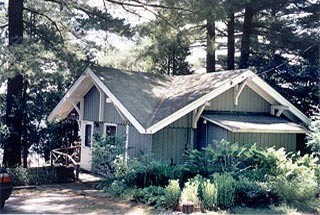
The next three pictures are of the cabins that are listed online. As of this writing, Twin Pines and Camp Brig O'Doon are showing vacancy during our week on their reservation calendar. The Gazebo instructs those interested to contact the owners during this time. The most affordable option among these are the two cabins at Brig O'Doon, with one unit for $600 per week (max 4 people) and one for $900 per week (rate for 4, or $1000 for 6 people). Click on the caption to see each property's detailed description and more pictures.


Twin Pines on Osgood Pond, listing on Adirondack "By Owner."

Camp Brig O' Doon on Osgood Pond, listing on Adirondack "By Owner"

The Gazebo on Osgood Pond, listing on Adirondack "By Owner"
Other nearby alternatives include Adirondack Swim and Trip Camp on Jones Pond (they generally confirm reservations in January and tend to fill up - send them an E-Mail early if you are interested; see my blog post about ASTC here), Lake Clear Lodge & Retreat and Charlie's Inn. In addition to RV campgrounds, Charlie's Inn also has rooms and a cabin to rent. The next option would be to look for lodging in and around the Village of Saranac Lake, which has a search engine with listings here.

Many of the lodging options will be fully booked during the week of our stay. If you are interested in joining us, please contact me directly, and I will be happy to help look for a place that fits your needs.

(Return To Main Page)

Saturday, November 15, 2014

A Short History of Paul Smiths

As I have mentioned before, the Adirondack Park is a place of beauty with unique dimensions. Including some 6.1 million acres, it is the largest park in the contiguous United States, and it is a matter of pride among New Yorkers that it is a state park, with a forrest preserve protected as "Forever Wild" by the NY State constitution, "and thus enjoys the highest degree of protection of wild lands in any state." The park easily merits a visit on the virtue of its sheer physical dimensions and beauty alone, to experience the mountains, lakes and streams, as well as the wildlife and vegetation. However, it would be a glaring omission to overlook the human history of the Adirondack Park.

The Adirondacks are a microcosm of the history of the United States. The park bears witness to so many elements of the American journey, from trading animal skins with native peoples, to the preindustrial activities such as logging and mining, to the rise of the "robber barons" in the industrial age, the scars left by the resulting pollution including notably acid rain, to the developing awareness of the need for conservation and protection of the wilderness. If you know where to look, it is easy to explore a cross section of these historical developments while visiting the Adirondacks, the hamlet of Paul Smiths and even White Pine Camp itself.

To properly explore the human history of the park, you would need to go back long before the time of the British Colonies here and learn about the Haudenosaunee, more commonly known as the Iroquois Confederacy, consisting of the Seneca, Cayuga, Onondaga, Oneida and Mohawk peoples. Early settlers came to trade furs with them, some with the intention to convert them to Christianity.

The European settlers were active in trapping, hunting and fishing in the Park. As the United States came into existence and its economy grew, the natural resources of the park were exploited, including logging for building timber and paper pulp. Mining also played a significant role in the park's history.
Miners in Joker Mine, Photo Credit: Adirondack Museum
These endeavors were intertwined with the rise of the industrial age and the "robber barons" who majestically capitalized on them. The Rockefellers, Vanderbuilts and J.P. Morgan are notable among many of the rich and powerful who staked a claim in the Adirondacks, commissioning the construction of great camps.

Much in the sense that the Adirondacks is a microcosm of American history, the hamlet of Paul Smiths is a microcosm of Adirondack history, and by extension, White Pine Camp is a microcosm of the history of Paul Smiths, named after Apollos (Paul) Smith, the decisive personality who shaped this area, its economy and the utilization of the park.

Map of Paul Smiths plus Osgood Pond and Jones Pond, from google maps
Smith, born August 20, 1825 in Milton VT and died December 15, 1912 in Montreal, Canada, was an inkeeper, a lumber baron, land developer, shrewd businessman and avid outdoorsman. At the age of 16, he left home to work on a canal boat on Lake Champlain and went hunting and fishing in the Adirondacks in his spare time. He gained a reputation as a hunting and fishing guide in the Loon Lake region.
Photo Credit: Wikipedia 
From his earnings, in 1848 he rented a house on Loon Lake which he ran as a small hotel that was frequented by doctors and lawyers and other wealthy guests. In 1852, he bought 200 acres near Loon Lake for $300 and opened "Hunter's Home," a fairly primitive operation. The ground floor consisted of a large living room, kitchen and a barrel of whiskey with a dipper. Drinks were self-service at four cents each, on the honor system. The upper floor consisted of ten small, simple sleeping quarters. The endeavor was hugely successful, and Smith's clientele, with whom he had developed relationships over the years, suggested that he build a more substantial hotel. Thus was born the Saint Regis House, known better as Paul Smith's Hotel, probably the most famous Adirondack hotel of all time. I highly recommend taking a look at the article on localwiki about the hotel, it includes numerous fascinating pictures.

Paul Smith's Hotel, circa 1892, Photo Credit: Wikipedia
Paul Smith's Hotel was opened in 1858 with seventeen rooms. Over the next three decades, it grew to five hundred rooms along the shoreline of Lower Saint Regis Lake. His clients were among the wealthy elite of the day who in turn wanted to build their own private Adirondack Camps, which furthered Smith's business endeavors even more.

Smith was a real estate developer on a huge scale. He purchased as much land as possible around his hotel, at one point owning up to 40,000 acres. He also knew the art of the deal, selling four acres (some accounts say five acres) in 1896 for $20,000, exactly the same amount he paid for 13,000 acres just a few years earlier. That's about $570,000 in 2014, adjusted for inflation.

Fun fact: how big is 40,000 acres anyway?

To put it into the context of the Adirondack park, Smith's holdings amounted to roughly 0,66% of the total area of the 6,100,000 acre park. By the way, there are 99 countries and dependencies in the world (out of 249 in total) that have a total area smaller than that of the Adirondack Park, including Belize, Slovenia and Israel. Bosnia and Herzegovina is slightly more than twice the size of the Adirondack Park.

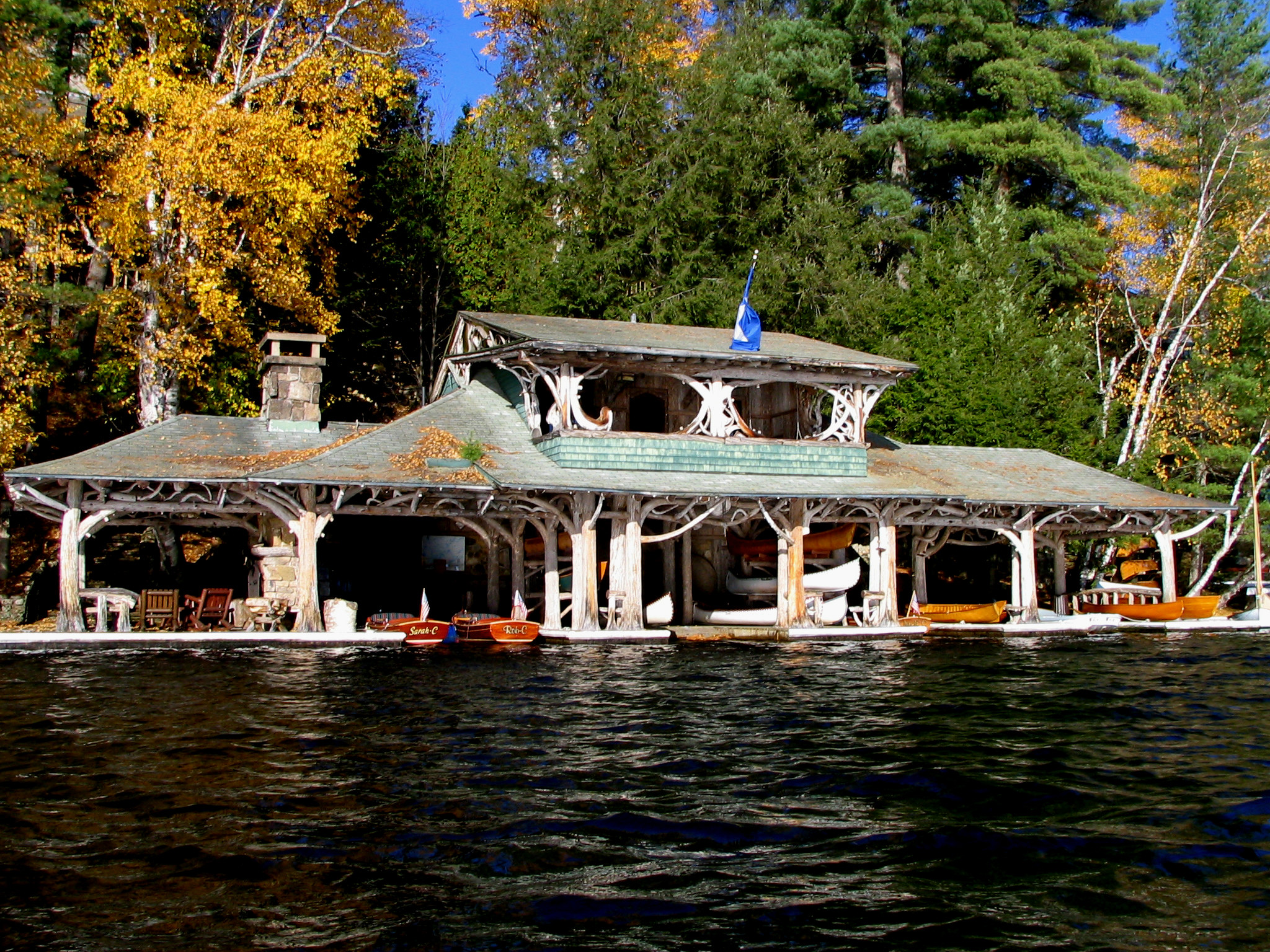
Many of the most famous Great Camps of the Adirondacks were built on land purchased from Smith and constructed with wood from his mills.

One of the Boathouses of Camp Topridge, on Upper St. Regis Lake, Photo Credit: Wikipedia
One of Smith's many clients was Archibald S. White, a prominent New York banker, and his wife Olive. The Whites purchased 35 acres on what is now known as Osgood Pond, and in 1908, the construction of White Pine Camp began, joining the ranks of the Adirondack Great Camps.

The Old Boathouse at White Pine Camp
Smith's business ventures were highly diversified. Some of his operations were typical of what one would expect in the Adirondacks: logging, developing and operating a saw mill, stores and shops. However, his operations were much more wide ranging. He also built an electric railroad to make the seven mile connection to the Mohawk and Malone Railway. Another technological development was the creation of the area's first electric company, with several hydroelectric plants. He also built roads, developed electric boats, installed telegraph lines and a stock ticker which was wired directly to the New York Stock Exchange. Later, he even set up a telephone system. Some of the activities of Apollos (Paul) Smith may remind those of us working at a particular "electrification company" here in Germany of another historical inventor and industrialist who lived during the same era.

Paul Smith's Electric Light and Power and Railroad Company
building in Saranac Lake, which now serves as the village offices
Photo Credit: localwiki
After Smith's death in 1912, his son Phelps Smith continued to operate the hotel until it burned down in 1930. When his son died, the funds in his will were provided to start Paul Smith's College, which offers degrees which are steeped in the tradition of what Apollos (Paul) Smith developed during his lifetime:


The history of White Pine Camp, is intertwined both in Smith's personal history and his legacy. In 1948, then owners Edith Stern & Adele Levy, daughters of Sears-Roebuck's Julius Rosenwald, donated the camp to Paul Smith's College. It was during this time, 1948 - 1983, that the camp fell into a state of disrepair through heavy use and years of abandonment from 1976 to 1983.

In 1983, Warren Stephen purchased the property and was able to stabilize some of the buildings. Ten years later, Howard Kirschenbaum purchased the camp and did extensive work to restore and overhaul it. Since 1997, White Pine Camp is operated as a LLC, with nearly 40 owners, many of whom take very much a hands-on approach to preserving and developing their camp. Reborn as a place of natural beauty as well as historic and architectural significance, the camp is strongly committed to being a place of living history. More details about the history of White Pine Camp can be found on their website.

Portions of the above sections were paraphrased from the localwiki article about Apollos (Paul) Smith, the description of White Pine Camp's history on the White Pine Camp website, and the book The Adirondacks, A History of America's First Wilderness, 1997, by Paul Schneider (available at amazon. com and amazon.de).

How to Experience Adirondack history and the legacy of
Apollos (Paul) Smith during your next trip to the Adirondacks

White Pine Camp on Google Maps


View White Pine Camp in a larger map